
Team Fortress 2
Team Fortress 2 jetim - baziran prvom licu pucač multiplejer video igra razvijena od strane Valve Corporation . To jenastavak originalnog mod tima tvrđave i njenog GoldSrc motora rimejk . To je prvi put objavljen kao deo kompilacije video igreOrange Bok 10. oktobra 2007 za Vindovs i Ksbok 360. . PlaiStation 3 verzija potom 22. novembra 2007 Igra je kasnije izdata kao . samostalni paket za Vindovs 8. aprila 2008 , za OS Ks dve godine kasnije , a za Linuk 14. februara 2013 . Team Fortress 2 se distribuira na mreži kroz preuzimanje maloprodajnog pare , dok je maloprodaja obrađuju Electronic Arts . Dana 23. juna 2011 ,igra je postalaslobodno - za - igru naslov , uz podršku microtransactions za jedinstvenu opremu u igri kroz pare . Razvoj Team Fortress 2 je predvodio Džon Kuk i Robin Voker , koji je prvobitno kreirao Team Fortress modifikaciju za Kuake u 1996 .
Igra je raspisan 1998 , a prvi put je pokreće motor GoldSrc Valve , ali to promenilo dok je prolazio kroz nekoliko različitih faza dizajna . Godine 1999 ,igra izgleda da se odstupa od svojih prethodnika po sledila realniju i militaristički stil igre , ali njegov dizajn preobrazio preko eventualni period razvoja devet godina . Konačni vizuelni uticajem umetnosti JO Leiendecker , Dean Cornvell i Norman Rokvel Rendition sportski crtani stil i pokreće motor Izvor . Sama igra se vrti oko dva tima, svaki sa pristupom devet različitih likova , boreći se u različitim režimima igre postavljenih u različitim okruženjima ili mape , često sa fabrički skladišta temu .
Nedostatak informacija ili prividne napredak za šest godina originalnog razvoja ove igre je to prouzrokovalo da se označi kao Vaporvare , a to je redovno sadržanu u Vired Nevs ' godišnjoj Vaporvare listi među ostalim ignominies . Nakon njegovog izlaska ,igra dobila kritična Priznanja i nekoliko nagrada , koji se pohvalio za njenu grafički stil , uravnotežen igre , humor , i za njegovu upotrebu punih karaktera ličnosti u posebnom multiplejer - samo igra.
| Team Fortress 2 | |
|---|---|
 The box art for the standalone PC version of Team Fortress 2 | |
| Developer(s) | Valve Corporation |
| Publisher(s) | Valve Corporation, Electronic Arts |
| Distributor(s) | Electronic Arts (retail) Steam (online) |
| Designer(s) | John Cook Robin Walker |
| Composer(s) | Mike Morasky |
| Series | Team Fortress |
| Engine | Source |
| Platform(s) | Windows, Xbox 360,PlayStation 3, OS X, Linux |
| Release date(s) | |
| Genre(s) | First-person shooter |
| Mode(s) | Single-player, multiplayer |
| Distribution | Optical disc, Download |
Kao i njegovi prethodnici , Team Fortress 2 je fokusiran oko dve suprotstavljene ekipe , pouzdanost iskopavanja i rušenje (crveno) i graditelje Liga Sjedinjene ( BLU ) nadmeću za borbenu zasnovan osnovnog cilja . Igrači mogu da izaberu da igraju kao jedan od devet klasa u ovim timovima , svaka sa svojim jedinstvenim snaga, slabosti i oružja . Iako su sposobnosti niza klasa su se promenila iz ranijih inkarnacija Team Fortress , osnovni elementi svake klase su ostali , a to je jedan primarni oružje , jedna srednja oružje , a jedan bliski oružje igra je objavljena . sa šest službenih mapama , iako 44 ekstra mape , 9 Arena mape , 8 King of the Hill karata , i razne druge vrste mape su uključeni u kasnijim promenama Pored toga . ,broj zajednice okupili su mape pušten . Kada igrači pridruže nivo po prvi put ,uvodni video pokazuje kako da završi svoje ciljeve . Tokom utakmice , "administrator " , žena izrazio Ellen Mclain , najavljuje različite događaje Game Over zvučnika . Granica/Igrač 16 na Xbok 360 i PlaiStation 3. Na PC računaru , u 2008 . Ventil ažurirani Team Fortress 2 uključiti servera promenljivu koja omogućava i do 32 igrača . Treće partijske modifikacije su omogućili da ugosti do 54 igrača na jednom serveru .
Team Fortress 2 jeprvi od ventila multiplejer igre da obezbedi detaljne statistike za pojedinačne igrače . Oni uključuju : vreme provedeno igrajući kao svakoj klasi , najviše bodova dobija , a najviše snima ili ciljevi postignuti u jednom životu . Trajni statistika reći plejer kako on ili ona se popravlja u odnosu na ove statistike , kao što su , akoigrač dođe blizu njegovog rekord za štetu u krugu Team Fortress 2 poseduje brojne " dostignuća " za . obavljanje određenih zadataka , kao što je postigao određeni broj ubistava ili završe rundu u određenom vremenu . Nove kompleta klase specifične dostignuća su dodate u novostima , koji dodaju nove sposobnosti i oružja za svaku klasu jednom otključana od strane igrača . Ovaj Unlockable sistem je od tada proširila u slučajnih sreću , gdeigrač takođe može da dobije stavke jednostavno igrajući igru . Dostignuća otključana i statistike iz prethodno odigranih utakmica su prikazani na igrača Steam ili Xbok Live profila strana .
The objective of the game is defined by the game mode in use.
- In Capture the Flag maps, the objective for both teams is to obtain a briefcase of intelligence from the enemy team's base and return it to their own base while preventing the opposing team from doing the same. The player carrying the intelligence can be killed to drop the briefcase, or the player can willingly drop it; in either case this starts a brief timer. If the intelligence is not collected by another player on the opposing team before that timer expires, it is returned to its home base. A team can only score by delivering the enemy's intelligence to their base. A match lasts until one team scores a set number of points or time runs out.] A variant of Capture the Flag, called Special Delivery, has teams vying over a single briefcase to attempt to deliver to a common target. Once the intelligence is picked up by one team, only members of that team can carry it until either it successfully delivered, or the drop timer expires and it is returned to its original spawn point.
- Control Point modes are more varied in their objectives, but share the common aim of capturing a particular point on the map by having one or more team members stay on the point without the presence of the opposing team for a short period of time. In standard control point maps, each team already controls an equal number of points, with one additional point left unclaimed; teams can only attempt to capture points that are nearest to those points they already control. Each team attempts to progressively capture all the control points to win the round. In attack/defend-style maps, the RED team already controls all the points on the map, and must hold these points from being captured by the opposing team (BLU Team) for a length of time. Attack/defend-style maps can come in either single-round or multiple-round maps; Rounds past the first will only be played if BLU wins a round.
- Territorial control is a more complex version of Control Point, in which each map is divided into a number of closed sections, held between the two teams. Each round has one team attempting to seize control of the opposing team's capture point for that section in a fixed amount of time. Once a team holds all but the enemy's home base point, they then attempt to capture the enemy base point while the enemy defends for a fixed amount of time.
- King of the Hill features a single control point in the center of the map, with teams vying for control over it. The control point is locked for a set amount of time after the round start. Once the point is unlocked, either team can capture it. Capturing the control point starts the team's clock counting down. The clock that is currently counting down will only stop if the other team captures the point, the clock reaches 0:00, or another map-specific event occurs such as a Halloween boss spawning during the Halloween event. Teams win the round when their clock reaches 0:00 with the control point currently under their control. If the other team is capturing the point, the round will not end until the point's capture progress resets to 0.
- Payload maps feature a length of track atop which sits a bomb mounted on a cart. These maps come in two varieties. In normal Payload maps, one team must escort the cart through a series of checkpoints in a limited amount of time to reach a final target that the other team defends. The cart moves when one or more players of the team are near it without enemies nearby; during this, the cart heals and provides ammo to those close by. If no one is by the cart, it may move backwards towards the last checkpoint, or roll off uphill sections of the track. In Payload Races, both teams race to deliver a bomb-cart to a final target; there are no checkpoints and unmanned carts will not move in reverse, but still require team members nearby to fully complete uphill sections. Both types of Payload maps can come in single-round or multiple-round maps. In standard payload, further rounds will only be played if BLU wins. In Payload Race, all rounds will be played regardless of which team wins, but the winner of previous rounds starts with their cart farther up the track.
- Arena is a team deathmatch mode, typically occurring smaller environments featuring a single control point. In each round, players do not respawn on death; a team wins the round by capturing the control point or eliminating all of the other team members.
- Medieval mode can be played on maps dedicated to this mode, or enabled for any other mode type. This mode forces players to use melee or similar medieval weapons (such as the Sniper's bow and arrow), and alters other non-gameplay facets of the program, such as translating all in-game text chat in a rough version of Early Modern English.
- MvM - Mann vs. Machine - is a six player co-operative mode where the mercenaries are defending a structure against increasingly-difficult waves of robots. Players have the ability to buy upgrades and improvements between rounds using in-game money earned during previous waves.] A "Mann Up" version is available by purchasing tickets with real money to participate in larger events on official servers with the opportunity to win unique cosmetic items after successfully completing a Tour of Duty.
All modes with the exception of MvM can be played under "Highlander" rules, which limits teams to a maximum of 9 players each and forces each player to select a unique class to play. A Training mode exists to help new players get used to the game, using wooden target dummies for practice and to introduce them to concepts of the multiplayer modes. Game modes allowing respawn all have a delay before a player may respawn again, with the respawn system being set up in waves of 10 seconds. Since 2009, there is also typically a Halloween-themed variation on one or more of the above modes during the weeks around the holiday, with maps or modes updated to include themed decorations and often a more difficult challenge to the players. For example, for Halloween 2012, this included an extremely difficult Mann vs Machine round involving destroying more than 800 enemy forces. Due to popular demand of the Halloween events, Valve added Full Moon, the ability to play these events on the few days around the full moon throughout the year, and later Eternaween, the ability for players to vote to play the themed-events for a two-hour block at any other time.
Classes and characters
There are nine unique player classes in Team Fortress 2, categorized into offense, defense, and support roles. Valve has stressed their focus on game balance when considering new improvements to the character classes, as every class has its own strengths and weaknesses which leads to reliance on other classes in order to be efficient. This forces gameplay into more strategic thinking and an increased utilization of teamwork than would be found if one class had inherent superior advantages. Each class has at least three weapons: a unique primary weapon, a common or unique secondary weapon and a distinct melee weapon in keeping with the character. They are as follows:
- The first offensive class is the Scout (voiced by Nathan Vetterlein). He is a fast-talking, cocky, baseball fan and street runner from Boston, Massachusetts, who practiced running to "beat his maddog siblings to the fray." As a result, he is a fast, agile character, armed with a scattergun, a pistol and an aluminum baseball bat. The Scout is capable of performing double jumps and also captures control points and pushes payloads twice as fast as other classes, but he (along with the Sniper and Spy) has the lowest health. The Meet the Spy trailer revealed that his mother is in a romantic relationship with the Spy.
- The Soldier (voiced by Rick May) is significantly more durable, but is consequently slower in his speed. A stereotypical highly patriotic American military man (despite the fact that he was never actually in the Army), the Soldier is armed with a rocket launcher, shotgun, and a folding shovel for melee combat. The explosion from the rocket launcher can be used to rocket jump to higher positions, similar to the mechanic from the game Quake, at the cost of self-damage.
- The final offensive class is the Pyro (voiced by Dennis Bateman), a mentally-unstable pyromaniac of unknown origin or gender, completely clad in a fire-retardant suit and a voice-muffling gas mask. The Pyro is armed with a homemade flamethrower as its primary weapon—this can set other players on fire, as well as being able to produce a blast of compressed air that knocks nearby enemies and projectiles away and can extinguish friendly players who are on fire. The Pyro uses a shotgun as its default secondary weapon, and uses a fire axe for melee combat.

- The first defensive class is the Demoman (voiced by Gary Schwartz). He is a black, one-eyed Scotsman who drinks heavily and hails from Ullapool, Scotland. Armed with a glass bottle, grenade and sticky bomb launchers, the Demoman can use his predominantly and high-damage weaponry to provide indirect fire and set traps against enemies.
- The Heavy (also voiced by Schwartz) is a stereotypical Russian character, heavy in both figure and accent. Obsessed and affectionate with his guns, his position as the strongest class allows him to sustain and deal immense amounts of damage at the cost of being the slowest class. His default weapons consist of his own fists, a shotgun, and an enormous minigun that he affectionately refers to as "Sasha".
- The Engineer (voiced by Grant Goodeve) is the last defensive class, portrayed as a relaxed and intellectual "good ol' boy" fromBee Cave, Texas. The Engineer is capable of building a number of structures to support his team: a tripod sentry gun for defending key points, a health and ammunition dispenser, and a one-way teleporter system, which can be upgraded to become a two-way teleporter system in the game mode "Mann vs. Machine." He is armed with a standard shotgun and pistol as his first two weapons, and a wrench melee weapon which is also used to repair, upgrade, and speed up building of his structures. He also has a remote that can detonate anything he has built, but has not been destroyed.
- The first support class is the Medic (voiced by Robin Atkin Downes), a German doctor from Stuttgart with little regard for the Hippocratic Oath, responsible for keeping his teammates alive. The Medic is accordingly armed with a special "Medi Gun", which both heals teammates and gradually builds "ÜberCharge"; upon charging, the gun grants boosts (such as temporary invulnerability) for the patient and Medic. The Medic is also equipped with an air-powered syringe gun and a bonesaw as his melee weapon to fight if the need arises.
- The Sniper (voiced by John Patrick Lowrie) is a cheerful Australian ocker-style character who rationalizes his line of work, equipped with a laser-sighted sniper rifle to shoot enemies from afar, as well as a submachine gun and a kukri for close combat.
- The last support class is the French, deadpan Spy (also voiced by Dennis Bateman): in addition to a revolver, he is equipped with covert tools, such as a cloaking devicedisguised as a watch, an electronic sapper used to sabotage and potentially destroy enemy Engineers' buildings, and a device hidden in his cigarette case that enables him to disguise as other players. The Spy can also use his butterfly knife to stab enemies in the back or sides (known as a backstab), which instantly kills them. The Meet the Spytrailer reveals that he is in a romantic relationship with the BLU Scout's mother, much to the latter's dismay.
Outside the main cast, there a few characters beyond the playable classes. This primarily includes the Administrator (voiced by Ellen McLain), an unseen announcer who provides information regarding time limits and objectives to players. The said cast has also expanded with subsequent Halloween updates, which includes Merasmus, the Bombinonicon, and the Mann Brothers (all voiced by Nolan North).
Competitive play
 Team Fortress 2 is also played competitively, through multiple unofficial leagues. The North American league ESEA supports a paid Team Fortress 2 league, with $10,080 in prizes for the top teams in 2012. In addition, TF2 is played in multiple free-to-play leagues including UGC (United Gaming Clans) and ETF2L in Europe. Competitive Team Fortress 2 is played mostly in one of two gamemodes: Highlander (one of each class, 9 players per team) or 6v6 (2 scouts, 2 soldiers, 1 medic, and 1 demoman, with other classes used in certain situations). While formalized competitive gameplay is very different from normal TF2, it offers an environment with a much higher level of teamwork than in public servers (also known as "pubs"). Most teams use a VOIP program to communicate, and use a combination of strategy, communication, and aiming ability to win against other teams. Many competitive leagues also feature an item banlist, in order to speed up gameplay and remove untested or undesirable strategies from matches.
Plot
Although the Team Fortress 2 storyline does not appear in-game, the story has been revealed in comics on the official website. The action takes part in an alternative history.
Redmond, Blutarch, and Gray Mann were born in 1822 as fraternal triplet sons of a wealthy Englishman, Zepheniah Mann, the owner of a successful arms manufacturing business. Gray, already sentient, intelligent and capable of fluent speech, was kidnapped by an eagle within minutes of birth during the Great Eagle Scourge of 1822 and goes missing for several years; Zepheniah would withhold knowledge of Gray from everyone else. Redmond and Blutarch were extremely competitive, attempting to vie for favor from their elderly father as to inherit the company after his death. In the 1860s, they convinced Zepheniah to purchase numerous pieces of land in the United States as assets for the company (under the mistaken belief that steam engines ran on gravel, and that the land was filled with it), but once they traveled there, they found the land to be barren dustbowls, with only the occasional gravel pit. Further, the travel caused Zepheniah to come down with numerous maladies, and died soon thereafter. In his will, Zepheniah bequeathed his munitions company, Mann Co., to his aide and tracker, the Australian hunter Barnabas Hale and his estate to his maidservant, Elizabeth. As punishment for their reckless and short-sighted scheme, Zepheniah's will ordered that Redmond and Blutarch were to share the worthless land they had made him acquire. Soon, Blutarch created his own company, Builders League United (BLU), and hired mercenaries to take the land by force; Redmond followed suit with his own company, Reliable Excavation Demolition (RED).
Their battles continued for forty years, with neither brother relenting. Blutarch realized that they would die soon, and hired an engineer, Radigan Conagher, to build him a life-extending machine, believing that by outlasting his brother, he would inherit the land by default and win. Conagher was later met by a mysterious woman that offers him a stash of the valuable metal Australium in exchange for building Redmond an identical machine. Conagher agrees, but later it is shown that he also built a third identical machine for an unknown entity.
Battles between RED and BLU continued for over sixty years; both Redmond and Blutarch hired new mercenaries to fight for them in 1968. By that time, their battles are overseen by the Administrator, the granddaughter of Elizabeth, while the Australian Saxton Hale has become CEO of Mann Co, the company that provides all the weaponry for both sides of the conflict.
In 1972, Redmond and Blutarch are brought together through letters they believed were sent by the other. Both, having cheated death for many years, realize their folly and propose a truce to create a machine that will make one of them pregnant and produce an heir. Gray, (who has returned after many years) reveals himself as their brother and arranger for the meeting, and tries to convince them that instead of fighting over worthless gravel they should take over the technology-savvy Mann Co., which he believes should be theirs by birthright. Neither Blutarch or Redmond agrees, being obsessed with gravel, and Gray kills them both.
Gray then uses his own army of robots to attack Mann Co. facilities all across the world. Saxton Hale hires the mercenaries, who are jobless since their employers were killed, to defend the Mann Co. sites against Gray's army of robots (who are themselves based on the mercenaries). Soon, however, the war develops into an "intractible stalemate."
Some time later, Gray tricks Hale out of ownership of Mann Co. by forcing him to lose a fight against Gray's young daughter, Olivia. Hale leaves the country, the mercenaries are fired again, and the Administrator disappears. Six months later, the Administrator is revealed to have previously stolen Mann Co.'s massive Australium deposits, and sends her assistant, Miss Pauling, to collect the mercenaries. After recruiting several of the mercenaries, Pauling discovers that the Spy and the Scout have been imprisoned in the American town of Teufort, near the contested gravel pits, and sentenced to death for their role in the previous battles - and to cover up the incompetence of Teufort's own mayor.
Pauling manages to pacify the citizens of Teufort and rescue the mercenaries. Meanwhile, Hale seeks help from his ex-girlfriend, Maggie, and her boss, zoo magnate and Hale's old rival Charles Darling, to regain control of his company. In the meantime, in Siberia the Heavy receives word from Miss Pauling, but dismisses the letter.
Development
Origins
Team Fortress originally began life as a free mod for Quake. Development on Team Fortress 2 switched to the GoldSrc engine in 1998 after the development team Team Fortress Software—consisting of Robin Walker and John Cook—were first contracted and finally outright employed by Valve Corporation. At the point of Team Fortress Software's acquisition production moved up a notch and the game was promoted to a standalone, retail product; to tide fans over, work began on a simple port of the game which was released in 1999 as the free Team Fortress Classic. Notably, Team Fortress Classic was built entirely within the publicly available Half-Life Software Development Kit as an example to the community and industry of its flexibility.
Walker and Cook had been heavily influenced by their three-month contractual stint at Valve, and now they were working full-time on their design, which was undergoing rapid metamorphosis. Team Fortress 2 was to be a modern war game, with a command hierarchy including a commander with a bird's-eye view of the battlefield, parachute drops over enemy territory, networked voice communication and numerous other innovations.
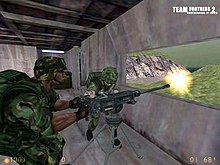
Early development
The new design was revealed to the public at E3 1999, where it earned several awards including Best Online Game and Best Action Game By this time Team Fortress 2 had gained a new subtitle, Brotherhood of Arms, and the results of Walker and Cook working at Valve were becoming clear. Several new and at the time unprecedented technologies on show: Parametric animation seamlessly blended animations for smoother, more lifelike movement, and Intel's multi-resolution mesh technology dynamically reduced the detail of on-screen elements as they became more distant to improve performance (a technique made obsolete by decreasing memory costs; today games use a technique known as level of detail, which uses more memory but less processing power). No release date was given at the exposition.
In mid–2000, Valve announced that development of Team Fortress 2 had been delayed for a second time. They attributed the delay to development switching to an in-house, proprietary engine that is today known as the Source engine. It was at around this time that all news ran dry and Team Fortress 2 entered six years of silent development. During that time, both Walker and Cook worked on various other Valve projects—Walker was project lead on Half-Life 2: Episode One and Cook became a Steam developer raising doubts that Team Fortress 2 was really the active project that would be repeatedly described.
Final design
The next significant public development occurred in the run up to Half-Life 2's 2004 release: Valve's director of marketing Doug Lombardi claimed that Team Fortress 2 was still in development and that information concerning it would come after Half-Life 2's release. This did not happen; nor was any news released after Lombardi's similar claim during an early interview regarding Half-Life 2: Episode One. Before Episode Two's release Gabe Newell again claimed that news on Team Fortress 2 would be forthcoming, and Team Fortress 2 was re-unveiled a month later at the July 2006 EA Summer Showcase event.


Walker revealed in March 2007 that Valve had quietly built "probably three to four different games" before settling on their final design. Due to the game's lengthy development cycle it was often mentioned alongside Duke Nukem Forever, another long-anticipated game that had seen many years of protracted development and engine changes. The beta release of the game featured six multiplayer maps, of which three contain optional commentary by the developers on the game design, level design and character design, and provide more information on the history behind the development.
Team Fortress 2 does not attempt the realistic graphical approach used in other Valve games on the Source engine such as Half-Life 2,Counter-Strike: Source and Day of Defeat: Source. Rather, it uses a more stylized, cartoon-like approach "heavily influenced by early 20th century commercial illustrations" and achieved with extensive use and manipulation of phong shading. The development commentary in the game suggests that part of the reason for the cartoonish style was the difficulty in explaining the maps and characters in realistic terms. The removal of an emphasis on realistic settings allows these explanations to be sidestepped. The game debuted with theSource engine's new dynamic lighting, shadowing and soft particle technologies, among many other unannounced features, alongside Half-Life 2: Episode Two. Team Fortress 2 was also the first game to implement the Source engine's new Facial Animation 3 features.
The art style for the game was inspired by J. C. Leyendecker, as well as Dean Cornwell and Norman Rockwell. Their distinctive styles of strong silhouettes and shading to draw attention to specific details were adapted in order to make the models distinct, with a focus on making the characters' team, class and current weapon easily identifiable. Silhouettes and animation are used to make the class of a character apparent even at range, and a color scheme that draws attention to the chest area brings focus to the selected weapon. The voices selected for each of the classes were based on imagining what people from the 1960s would expect the classes to have sounded like, according to writer Chet Faliszek.
The map design has a strong evil genius theme with archetypical spy fortresses, concealed within inconspicuous buildings such as industrial warehouses and farms to give plausibility to their close proximities; these bases are usually separated by a neutrally-themed space. The bases hide exaggerated super weapons such as laser cannons, nuclear warheads, and missile launch facilities, taking the role of objectives. The maps have little visual clutter and stylized, almost impressionistic modeling, to allow enemies to be spotted more easily. The impressionistic design approach also affects textures, which are based on photos that are filtered and improved by hand, giving them a tactile quality and giving Team Fortress 2 its distinct look. The bases are designed to let players immediately know where they are. RED bases use warm colors, natural materials and angular shapes, while BLU bases use cool colors, industrial materials and orthogonal shapes.
Release
During the July 2006 Electronic Arts press conference, Valve revealed that Team Fortress 2 would ship as the multiplayer component of The Orange Box. A conference trailer showcasing all nine of the classes demonstrated for the first time the game's whimsical new visual style. Managing director of Valve Gabe Newell said that the company's goal was to create "the best looking and best-playing class-based multiplayer game". A beta release of the entire game was made on Steam on September 17, 2007 for customers who had pre-purchased The Orange Box, who had activated their Black Box coupon, which was included with the ATI HD 2900XT Graphics cards, and for members of the Valve Cyber Café Program. The beta continued until the game's final release.
The game was released on October 10, 2007, both as a standalone product via Steam and at retail stores as part of The Orange Box compilation pack, priced at each gaming platform's recommended retail price. The Orange Box also contains Half-Life 2, Half-Life 2: Episode One, Half-Life 2: Episode Two, and Portal. Valve offered The Orange Box at a ten percent discount for those who pre-purchased it via Steam before the October 10, as well as the opportunity to participate in the beta test.
Post-release
Since the release of Team Fortress 2, Valve has continually released free updates and patches through Steam for Microsoft Windows, OS X, and Linux users; though most patches are used for improving the reliability of the software or to tweak gameplay changes, several patches have been used to introduce new features and gameplay modes, and are often associated with marketing materials such as comics or videos offered on the Team Fortress 2 website; this blog is also used to keep players up to date with the ongoing developments in Team Fortress 2. As of July 2012, each class has been given a dedicated patch that provides new weapons, items, and other gameplay changes; these class patches typically included the release of the class's "Meet the Team" video. Other major patches have included new gameplay modes including the Payload, Payload Race, Training, Highlander, Medieval,and Mann vs Machine modes. Themed patches have also been released, such as a Halloween-themed map with unique items available only during a set period around the holiday. Other new features have given players the ability of crafting new items within the game, trade items with other players,purchase in-game items through funds in Steam, and save and edit replay videos that can be posted to YouTube.
Valve has released tools to allow users to create maps, weapons, and cosmetic items through a contribution site; the most popular are added as official content for the game.This approach has subsequently created the basis for the Steam Workshop functionality of the software client. In one case, more than fifty users from the content-creation community worked with Valve to release an official content update in May 2013, with all of the content generated by these players. Valve reported that as of June 2013, over $10 million has been paid back to over 400 community members that have helped to contribute content to the game, including a total of $250,000 for the participants in the May 2013 patch.
Development of the new content has been confirmed for the Xbox 360, while development for the PlayStation 3 was deemed "uncertain" by Valve. However, the PlayStation 3 version of Team Fortress 2 received an update that repaired some of the issues found within the game, ranging from graphical issues to online connectivity problems; this update was included in a patch that also repaired issues found in the other games within The Orange Box. The updates released on PC and planned for later release on Xbox 360 include new official maps and game modes, as well as tweaks to classes and new weapons that can be unlocked through the game's achievement system. The developers attempted to negotiate with Xbox 360 developer Microsoft to keep the Xbox 360 releases of these updates free, but Microsoft refused and Valve announced that they would release bundles of several updates together to justify the price.
On June 10, 2010, Team Fortress 2 was released for OS X, shortly after the release of Steam for OS X. The release was teased by way of an image similar to early iPod advertising, showing a dark silhouette of the Heavy on a bright green background, his Sandvich highlighted in his hand. Virtual earbuds, which can be worn when playing on either OS X or Windows once acquired, were given to players playing the game on OS X before June 14, though the giveaway period was later extended to August 16.
On Nov 6, 2012, Valve announced the release of Team Fortress 2 for Linux as part of a restricted beta launch of Steam on the platform. This initial release of Steam and Team Fortress 2 was targeted at Ubuntu with support for other distributions planned for the future. Later, on Dec 20, 2012, Valve opened up access to the beta, including Team Fortress 2, to all Steam users without the need to wait for an invitation. On February 14, 2013, Valve announced the full release of Team Fortress 2 for Linux. From then to March 1, anyone who played the game on Linux would receive a free Tux penguin, which can be equipped in-game.
Team Fortress 2 was announced in March 2013 to be the first game to officially support the Oculus Rift, a consumer-grade virtual reality headset. A patch will be made to the client to include a "VR Mode" that can be used with the headset on any public server.
Trading
On December 17, 2011 the gaming site Kotaku reported that the Team Fortress 2's trading economy was calculated to be worth over $50 million.
Free-to-play
On June 23, 2011, Valve announced that Team Fortress 2 would become a free-to-play title; the core game could be enjoyed for free, while unique equipment, character outfitting, and the like would be available as microtransactions through the in-game store tied through Steam. Though Valve will continue to add items to the store to support the game, Walker asserted they will continue to provide new features and items for free. Walker noted that through various promotions, Valve has come to understand the wide range of players that continue to play the game, and that for the multiplayer title, "the more people playing the game, the higher value the game has for each individual customer". The move came a week after Valve introduced several other third-party free-to-play games to the Steam service, and commented to journalists that they were working on their own free-to-play title. Within nine months of the move, Valve reported that revenues from Team Fortress 2 has increased twelve times from what they previously had seen before the switch.
Marketing

To promote the game, Valve has released an ongoing video advertisement series entitled "Meet the Team" since May 2007. Constructed using the game engine and slightly more detailed character models, the series consists of short videos on individual characters, displaying their personalities and tactics. The videos are usually interspersed with clips of the character in combat in the game. The manners which these are presented have varied drastically: the first installment, "Meet the Heavy", depicted an interview with the gun-obsessed Eastern European while "Meet the Soldier" showed the Soldier giving a misinformed lecture on Sun Tzu to a collection of severed heads as if to raw recruits. The videos are generally released through Valve's services, though in one notable exception, the "Meet the Spy" video was leaked on YouTube during the Sniper/Spy update week. The "Meet the Team" videos are based on the audition scripts used for the voice actors for each of the classes; the "Meet the Heavy" scripts is nearly word-for-word a copy of the Heavy's script. More recent videos, such as "Meet the Sniper", contain more original material. The videos have been used by Valve to help improve the technology for the game, specifically improving the facial animations, as well as a source of new gameplay elements, such as the Heavy's "Sandvich" or the Sniper's "Jarate". The final video in the Meet the Team series, "Meet the Pyro", was released on June 27, 2012. Newell has stated that Valve is using the "Meet the Team" shorts as a means of exploring the possibilities of making feature film movies themselves. Newell believed that only game developers themselves have the ability to bring the interesting parts of a game to a film, and suggested that this would be the only manner through which a Half-Life-based movie would be made. The shorts were made using Source Filmmaker, which was officially released and has been in open beta as of July 11, 2012.
In more recent major updates to the game, Valve has presented teaser images and online comic books that expand the fictional history of the Team Fortress 2, as part of the expansion of the "cross-media property", according to Newell. In August 2009, Valve brought aboard American comic writer Michael Avon Oeming to teach Valve "about what it means to have a character and do character development in a comic format, how you do storytelling". "Loose Canon", a comic associated with the Engineer Update, establishes the history of RED versus BLU as a result of the last will and testament of Zepheniah Mann in 1890, forcing his two bickering sons Blutarch and Redmond to vie for control of Zepheniah's lands between them; both have engineered ways of maintaining their mortality to the present, waiting to outlast the other while employing separate forces to try to wrest control of the land. This and other comics also establish other background characters such as Saxton Hale, the CEO of Mann Co., the company that provides the weapons for the two sides and was bequeathed to one of Hale's ancestors by Zepheniah, and the Administrator, the game's announcer, that watches over, encourages the RED/BLU conflict, and keeps each side from winning The collected comics were published by Dark Horse Comics in Valve Presents: The Sacrifice and Other Steam-Powered Stories, a volume along with other comics created by Valve for Portal 2 and Left 4 Dead, and released in November 2011. Cumulative details in updates both in-game and on Valve's sites from 2010 through 2012 were part of a larger alternate reality game preceding the reveal of the Mann vs Machine mode, which was revealed as a co-op mode on August 15, 2012.
Valve had provided other promotions to draw players into the game. Valve has held weekends of free play for Team Fortress 2. Through an early update, hats and accessories can be changed or added to any of the classes, giving players some ability to customize the look of their character. Hats can be gained as a rare random drop, through the crafting / trading systems, or via cross-promotion: Limited-edition hats have been awarded for pre-ordering or gaining Achievements in other content from Steam, both from Valve (such as Left 4 Dead 2 and Alien Swarm) or other third-party games such as Sam & Max: The Devil's Playhouse, Worms Reloaded, Killing Floor, or Poker Night at the Inventory (which features the Heavy class as a character). According to Robin Walker, Valve introduced these additional hats as an indirect means for players to show status within the game or their affiliation with another game series simply by visual appearance. The Red Pyro, Heavy, and Spy all function as a single playable character in the PC release of Sonic and All-Stars Racing Transformed. The game's first television ad premiered during the first episode of the fifth season of The Venture Bros. in June 2013, featuring in-game accessories that were created with the help of Adult Swim.
Reception
| Reception | ||||||||||||||||||||||||||||||||||||||||||||||||||||||||||||||||||||||||||||||||||
|---|---|---|---|---|---|---|---|---|---|---|---|---|---|---|---|---|---|---|---|---|---|---|---|---|---|---|---|---|---|---|---|---|---|---|---|---|---|---|---|---|---|---|---|---|---|---|---|---|---|---|---|---|---|---|---|---|---|---|---|---|---|---|---|---|---|---|---|---|---|---|---|---|---|---|---|---|---|---|---|---|---|---|
| ||||||||||||||||||||||||||||||||||||||||||||||||||||||||||||||||||||||||||||||||||
| ||||||||||||||||||||||||||||||||||||||||||||||||||||||||||||||||||||||||||||||||||

See also: Critical reception of The Orange Box
Upon release, Team Fortress 2 received widespread critical acclaim, with overall scores of 92/100 and 92.60%, respectively onMetacritic and GameRankings. Many reviewers praised the cartoon-styled graphics, and the resulting light-hearted gameplay,and the use of distinct personalities and appearances for the classes impressed a number of critics, with PC Gamer UK stating that "until now multiplayer games just haven't had it." Similarly, the game modes were received well, GamePro described the settings as focusing "on just simple fun", while several reviewers praised Valve for the map "Hydro" and its attempts to create a game mode with variety in each map. Additional praise was bestowed on the game's level design, game balance and teamwork promotion.Team Fortress 2 has received several awards individually for its multiplayer gameplay and its graphical style, as well as having received a number of "game of the year" awards as part of The Orange Box.
Although Team Fortress 2 was well received, Team Fortress 2's removal of class-specific grenades, a feature of previous Team Fortressincarnations, was controversial amongst reviewers. IGN expressed some disappointment over this, while conversely PC Gamer UKapproved, stating "grenades have been removed entirely — thank God". Some further criticism came over a variety of issues, such as the lack of extra content such as bots (although Valve have since added bots in an update), problems of players finding their way around maps due to the lack of a minimap, and some criticism over the Medic class being too passive and repetitive in his nature.The Medic class has since been re-tooled by Valve, giving it new unlockable weapons and abilities.
Team Fortress 2 Sajt
.png)


